Author Archives: Meghan Kelley

Upcoming Tradeshows

Upcoming Tradeshows

Planning on coming to visit us at a tradeshow? Schedule a meeting to speak one on one with our team!

Our 2026 Tradeshows

Event Dates Location Booth Show Homepage
AOC Europe May 19-21 Helsinki, Finland Booth #4C33 https://aoceurope.org/
Robotics Summit & Expo May 27-28 Boston, MA Booth #236 https://www.roboticssummit.com/
RSSI June 2-4 Omaha, NE Booth #1012 https://rssi.org/ 
IMS June 9-11 Boston, MA Booth #10604 https://ims-ieee.org/
7th Drone International Expo 2026 June 24-25 New Delhi, India Booth #D-12 https://www.droneinternationalexpo.com/
Farnborough International July 20-24 London, England Booth #1210 https://www.farnboroughairshow.com/
European Microwave Week October 4-9 London, England Booth #D60 https://www.eumw.eu/
AUSA National Meeting October 12-14 Washington, DC Booth #4124 https://meetings.ausa.org/annual/2026/
Hypersonic Missiles

Frequency Matters Podcast: Hypersonic Weapons with Dave Slack

Frequency Matters Podcast: Hypersonic Weapons with Dave Slack

Summary

Gary Lerude of Microwave Journal recently spoke with Dave Slack, Engineering Director at Times Microwave Systems®, on hypersonic weapons. Watch the complete video or read the session notes below.

Session Notes

Hypersonic weapons have been a hot topic in the news lately. Please give us some background on hypersonics and what all the buzz is about.

A really quick definition of hypersonic is that it describes any speed faster than five times the speed of sound (above Mach 5). The hypersonic weapon systems creating all the buzz today will go faster—about 10, 15, 20, or even 25 times the speed of sound.

Hypersonic technologies are not new; however, they have been around for 70 years or so since the end of World War II. Examples include Sputnik, the Apollo missions, SpaceX rockets, etc. What they all had in common is that they have a ballistic path, a parabolic arc set by the force of gravity and launch velocity. The path is very predictable, and it is easy to determine where the vehicle came from, where it’s going to land, etc., so it’s easy to defend against and countermeasure.

The difference today is that the new generation of hypersonic vehicles is steerable. This makes it challenging to determine precisely where it came from, which is a game changer. The weapon system that is getting the most attention right now is hypersonic glide vehicles. These are initially launched on a parabolic or ballistic arc but can drop down much lower in altitude mid-course and “glide” at a relatively low atmosphere at hypersonic speeds. As a result, they are much more challenging to detect.

Not only are these missiles traveling at hypersonic speeds, but they are also maneuverable. As a result, the time to react could be as little as two-three minutes compared to 45 minutes or an hour with other missile types, so they are very difficult to defend against. Additionally, there are hypersonic cruise missiles, powered vehicles with a scramjet or a supersonic ram jet. That is another game changer because it can travel at much lower altitudes at much longer ranges and is powered, so it’s not just gliding.

Given the physics associated with hypersonic speeds and the extreme environmental conditions, what kind of challenges or emerging technologies have hypersonics created?

The maneuverability factor is the primary issue when it comes to electronics. Every time the missile maneuvers, it loses energy, which is then dissipated as heat. This is in addition to the heat caused by the friction of slipping through the air stream. Dealing with that heat is one of the significant technical challenges.

Smart weapons are also precise and accurate, usually requiring someone on the ground to identify a target, communicate with the weapon, and guide it at hypersonic speeds. These vehicles are surrounded by a plasma envelope, which is why space vehicles lose communications for a few seconds on re-entry because the envelope shields them from communications. Penetrating the plasma envelope to communicate with the weapon and steer it creates another big technological hurdle. This drives the need to evaluate smaller, lighter options that can operate at higher temperatures.

RF microwave technology is used on hypersonic weapons in onboard systems for communication, as well as detection and countermeasures. I expect the RF microwave community will play an increasingly important role in countermeasures.

Do you have a sense of the market evolving over the next few years as research and development turn into actual fielded programs?

The armed services and government development agencies rely on industry to develop these weapons, components, and underlying technologies. As a result, a lot of investment will flood into this space because it is the department of defense’s number one development priority right now and will likely continue to be a top priority for at least the next ten years.

Supply chain disruptions for times microwave systems

Don’t let supply-chain disruptions knock your projects off schedule – navigate roadblocks and stay on track

Don’t let supply-chain disruptions knock your projects off schedule – navigate roadblocks and stay on track

Originally published in Military Embedded Systems 

By David Kiesling

In today’s unusually challenging environment, companies may need to look for workarounds to stay on track regarding supply chain and delivery. Some electronics companies are learning the hard way that supply-chain resilience is a critical qualification for doing business, whether in their own or in their business partners’ and suppliers’ operations. These lessons will change the way organizations consider procurement and production decisions for the future.

Every business – including those that supply the military-electronics arena – is feeling the pain of supply-chain problems these days. Many, in fact, are finding it impossible to run efficiently, meet demand, and deliver on time when necessary parts and materials are stuck in limbo.

Survival of the fittest

The current tight supply-chain situation is having a painful impact on many companies, slowing production as parts, materials, and labor become scarce. Whether you are waiting on products or services like installation and repair, deadline slippage is beyond frustrating. The delays can kill your revenue, cause you to lose loyal customers and new business, and damage your business relationships.

Planning for the long term might sound a bit ambitious when the more immediate problem is that today’s orders are stalled, so let’s start by discussing survival strategies for the current logjam.

Workarounds you can implement now

Decide first if your current suppliers can meet your immediate needs. Can you wait? If delays are seriously impacting your business, consider all your options. Not all products or suppliers are equally prepared to operate through a supply-chain crisis like this. Those with the lowest incidence of backlogs right now either laid the groundwork for resilience before 2020, or they pivoted quickly to prioritize supply-chain agility as the going got tough. The most successful probably did both.

Look around for alternate suppliers if you need to. You can minimize delays by working with the companies that can support your short-term needs more quickly than your existing partners can accommodate.

If you’re lucky enough to be getting what you need, when you need it, from your existing suppliers – consider placing or confirming orders and inventories as early as you can. That way, you won’t get left behind or caught short.

The long game

These challenges will light the way for successful organizations to prioritize resilience to grow and prosper in the future. How can you be better prepared for tomorrow, next month, next year? Survive the present, of course; protect your relationships and reputation as best you can, using the mitigation tactics discussed above. While you’re at it, consider long-term changes that will better position your company for whatever lies ahead.

Find partners with multiple production facilities worldwide; they can often move your work to areas where bottlenecks are less severe so that changing global challenges don’t shut off your supply. Different regions of the world are feeling COVID-19 impacts and shipping snafus at different times, so redundant geographic capabilities can alleviate regional pressures.

For example: Over the past few years, Times Microwave Systems® strategically managed growth, preparing for a situation such as this by opening new manufacturing and warehousing facilities in China, India, and Europe. Moving production closer to customers allowed for shorter delivery routes and created more options for mitigating shifting labor and supply-chain issues. When difficulties arose, it was possible to maintain a steady inventory and supply of the products and services customers relied on.

Decentralized manufacturing capabilities enabled uninterrupted production throughout the pandemic, building inventory needed to meet immediate demand. By continually increasing on-hand stock for standard materials across internal and distributor-serviced warehouses, companies that prepared this way are now better-suited to weather the volatility in raw material costs, thereby resulting in more stable pricing for customers.

Flexibility and versatility should also be considered in business and supplier relationships. A company that offers custom solutions can work with you to develop the most feasible systems at the time. You can thus avoid getting locked into a one-size-fits-all system design that depends upon one source, one material, or one standard product that could be in short supply when you actually need it.

Watch out for false promises

Make sure you are buying genuine products from a reputable company to ensure your system works as it should. Shortages tend to bring counterfeits, fakes, and clones out of the woodwork, as unscrupulous operators look for ways to cash in on a crisis. The performance of your customers’ products depends on reliable product sourcing. Customers that unwittingly buy inferior products sold under false pretenses often pay the price with dismal system performance.

Moving through and forward

Do whatever you have to do to get through this crisis. Be flexible. Build resilience for the future. Work with organizations that are working through the current issues with minimal disruptions. And adjust your approach to qualifying the companies you work with so that you’ll be ready for the next uncertainty.


f-35-in-flight-2015

Adding new high-frequency capabilities to military avionics applications

Adding new high-frequency capabilities to military avionics applications

By Ted Prema

Originally published in Military Embedded Systems

The high-frequency radio frequency (RF) interconnections within military avionics systems are essential components. They must perform repeatably and reliably and meet reduced size, weight, and power (SWaP) requirements. At the same time, the RF coaxial cables and connectors operating in these critical avionics applications have complex electrical, mechanical, and environmental requirements and must remain accessible for maintenance or troubleshooting.

Additionally, fitting these systems into very tight spaces can allow unwanted coupling between RF transmission lines such as coaxial cables. High-density, modular multiport interconnect systems can create a smaller, modular connector assembly. Such multiport connector systems integrate multiple coaxial connector contacts into a single housing for much higher interconnection density than individual coaxial connections.

Frequency requirements are rising

Today’s military avionics technologies, in­cluding intelligence, radar, collision avoidance, electronic guidance, navigation, electronic warfare, and communications, require higher frequencies to provide increased bandwidth for a growing number of complex subsystems. Military avionics systems that once operated at frequencies of 12-18 GHz are now extending into the millimeter-wave (mmWave) frequency range of 30 GHz and beyond.

High-frequency RF interconnects for military avionics systems must retain their predecessors’ lightweight and small form factors to fit the high-density requirements of modern airframes and avionics systems. Driven by reduced SWaP equipment requirements, avionics systems are being mounted within smaller airframes and equipment housings, requiring coaxial assemblies to maintain reliable electrical and mechanical interconnections in tight spaces and under the most severe operating conditions.

Such a compact modular multiport connector system provides smaller, lighter interconnections to support denser, more tightly packed avionics systems. By mating a single multiport connector rather than multiple separate coaxial cable assemblies, the single connector interface provided by multiport shells reduces installation time, can ease system maintenance and testing, and increase reliability.

Expand capabilities within existing infrastructure

Military avionics interconnect systems operate in harsh environments on a wide range of airframes, enduring high-shock and vibration; corrosive effects of fuels, hydraulic fluids, and other chemicals; vacuum-like conditions created by high altitudes; and wide temperature ranges. These military avionics systems must handle these challenging environmental conditions while packing greater functionality into smaller spaces. This requires new coaxial cables and connectors to deliver high signal integrity and reliability.

Critical considerations for RF interconnects for challenging avionics and airframe applications include:

  • Lightweight: Weight reduction is critical to increasing fuel efficiency. Today’s frequency band requirements are also becoming more complex, creating the need for additional lightweight, small, high-precision RF solutions.
  • High density: The increasing number of antennas in military avionics applications creates the need for more electronic boxes and their connections. Furthermore, new high-density solutions are required as frequencies increase and interconnect dimensions decrease to accommodate shorter wavelengths.
  • Shock and vibration: When a connector attached to an antenna vibrates, as it will in flight, microphonic noise can impact the connection. This can cause interference in the signal transmission and errors for the RF system. Minimizing space between the cables and connectors is necessary for the interconnect system to survive the high vibration. Furthermore, this microphonic noise wears out the plating on the pins. Use of spring-loaded interfaces can all but eliminate this for both electrical and mechanical improvements.
  • Temperature: Higher altitudes, speeds, and frequencies result in higher temperature requirements, making materials considerations more complex.
  • Maintenance and access: Antennas mounted on the aircraft’s exterior are routinely damaged, and expedited repair of those antennas is essential. However, antennas are often difficult to access in many avionics systems, making maintenance and replacement very complicated and time-consuming.

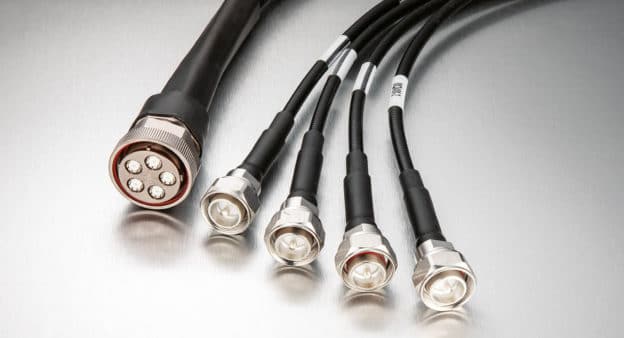
Multiport shells such as the M8 multiport connection system are constructed from lightweight aluminum and have advanced reach/ROHS-compliant conductive platings tested to the most severe corrosion resistance requirements. (ROHS is a directive on the restriction of the use of certain hazardous substances in electrical and electronic equipment.) The new contact designated M8M works up to 40 GHz and meets the needs of new high-frequency applications. The M8 multiport system has a a shielded structure to meet the electromagnetic interference and electromagnetic compatibility (EMI/EMC) requirements of densely packed military and civil avionics systems. The design also enables blind-mating interconnections. A spring-loaded design aims the parts for use in the harsh, high-vibration, environments typically found in military avionics applications. These parts are in service on a variety of U.S. and allied military aircraft from SIGINT/ELINT [signals intelligence/electronic intelligence] platforms to fast fighter jets.

Advanced military avionics electronics applications must accommodate extremely restricted space constraints and rising operating frequencies. A military avionics wireless system’s range that once operated between 12 and 18 GHz is now extending into the millimeter-wave (mmWave) frequency range of 30 GHz and beyond. High-frequency RF interconnects for military avionics systems must retain their predecessors’ light weight and small form factors to fit the high-density requirements of modern airframes and avionics systems.